The Freemium World: a business model for abundance
If AI drives marginal costs toward zero, abundance looks like Spotify: a free floor, a premium status game, and an escalator that never stops.
The usual debate about post-AGI abundance splits into two camps. The utopians say robots will make everything free, work will end, and we'll live like the Culture. The skeptics say that's absurd because positional goods (land, status, attention) can never become abundant, and material abundance alone wouldn't satisfy humans anyway.
The interesting question isn't whether we reach abundance. It's what the business model of abundance looks like on the ground, year by year, as AI drives marginal costs down.
The answer is already visible in how the internet economy works. Gmail is free. Spotify has a free tier. LinkedIn, Dropbox, Discord, YouTube: all freemium. This mechanism holds because digital marginal costs are close to zero. Chris Anderson wrote the book on this in 2009. His one-line dismissal of the atoms question is accurate, for now: “atoms would like to be free, too, but they're not so pushy about it”. (Chris Anderson's FREE)
But AI (plus robotics and general automation) changes that. Not because atoms become literally free. Because marginal costs drop low enough that freemium starts working for physical goods and services the way it already works for bits.
The cross-subsidy question isn't so hard
The first objection is always: who pays? If you give a robot butler away, somebody has to cover the energy, the maintenance, the depreciation.
Consider Gmail. Hosting, storage and bandwidth cost money. At Google's scale, the per-user annual cost is a few cents. The subsidy question is almost trivial because the number being subsidized is so small. Workspace fees alone would cover it without ads. Storage tiers would cover it without Workspace. Google has many ways of making free Gmail pencil out.
Apply the same logic to atoms. If and when AI plus robotics push the marginal cost of a robot-service-hour to $0.05, the question becomes: how do you cover $0.05 per hour? A premium tier fee. A slice of platform commerce. A small ad placement. A modest state subsidy funded by AI productivity taxes. Any one of these, in any combination.
@1x_tech is already shipping part of this logic. The NEO humanoid robot, available in 2026, costs $20,000 outright or $499 a month on subscription. NEO uses human teleoperation in its early rollout. Operators can see through the robot's cameras into the user's home. That's an early version of the data subsidy. Users pay with a slice of their privacy to make the lower tier economically viable. @joinshiftX has a similar model:

The data is particularly valuable in the early stages of this technology - add VC money to the mix and you get a surprisingly affordable robot butler.
Two engines keep the equilibrium stable
Freemium isn’t a destination as much as it is a dynamic equilibrium, held in place by two independent engines.
Engine one: polypolistic competition keeps lifting the floor.
The 2014 Samsung Galaxy and the 2025 iPhone are both "smartphones." To someone from 1925, they would be indistinguishably magic. To us, the gap is obvious and worth paying for. Competition between providers who need something to sell generates the next tier of capability, year after year, and yesterday's premium tier becomes tomorrow's baseline.
That's the escalator. It has been running since the Industrial Revolution. The 1900 working class would not comprehend 2025 Walmart conditions. AI and black factories only accelerate the escalator into categories it hasn't touched yet. The budget robot butler of 2045 will be unrecognizably better than the premium version of 2035, because multiple companies will be competing to sell you their premium one in 2046.
Sidenote: regulation can and will curb this - cars are a great example where government regulation makes the price-to-value ratio take a hit to force higher levels of safety.
Engine two: humans don't run out of status games.
Even if the free tier covers every material need someone could articulate today, the premium tier stays in demand. People keep generating new identity categories, trend cycles, in-group markers, and signaling opportunities that need expressing through consumption. More abundance has historically produced more status competition, not less, because it frees up cognitive and economic room for status games that were previously unaffordable. The 1925 working class worried about food. The 2025 working class has TikTok, luxury handbag dupes, and parasocial celebrity dynamics.
Bagwell and Bernheim's 1996 paper in the American Economic Review formalized it. When consumers signal status through consumption, budget tiers get priced at marginal cost while luxury tiers earn strictly positive profits, even when the luxury tier isn't intrinsically better.
The combination is the argument. Either engine alone is contestable. A skeptic could reasonably ask why competitors would keep innovating if everyone's satisfied, or whether people would transcend status games in a world of plenty. Both engines operating simultaneously are very hard to neutralize without denying either basic economics or human psychology.
This also absorbs the "positional goods never become abundant" critique cleanly. Yes, they don't. That's the point. Positional competition is what the premium tier is made of. The free tier covers the non-positional floor, positional competition organizes the premium tier, both keep improving.
The most likely subsidies
Classic freemium is funded by cross-subsidies and data/ads. My prediction is that this will not change and even extend to physical goods and services. Some examples:
Cross-subsidy: when you’re ordering your robotaxi, you may encounter a free tier in certain high-traffic areas that looks like this:
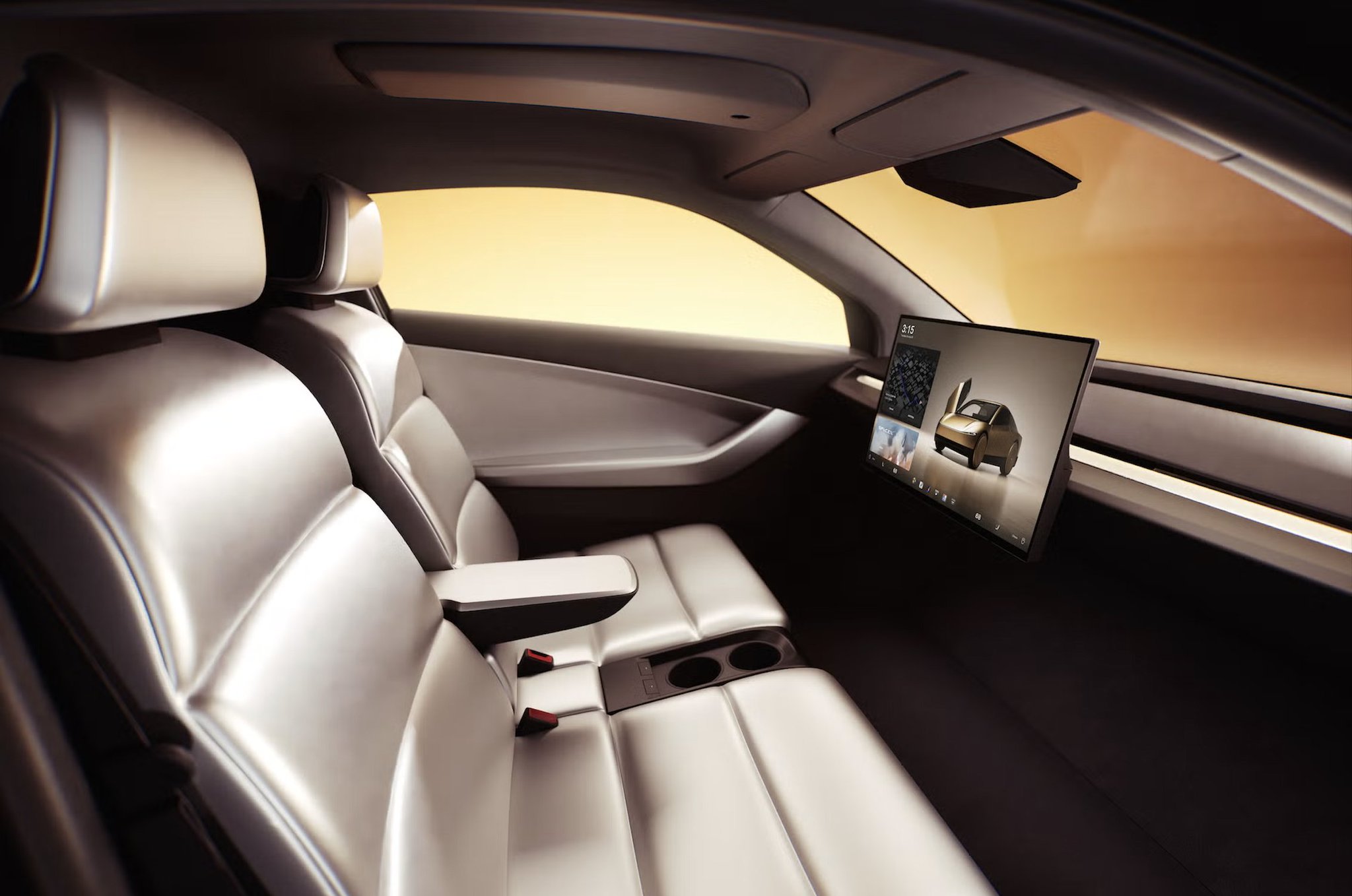
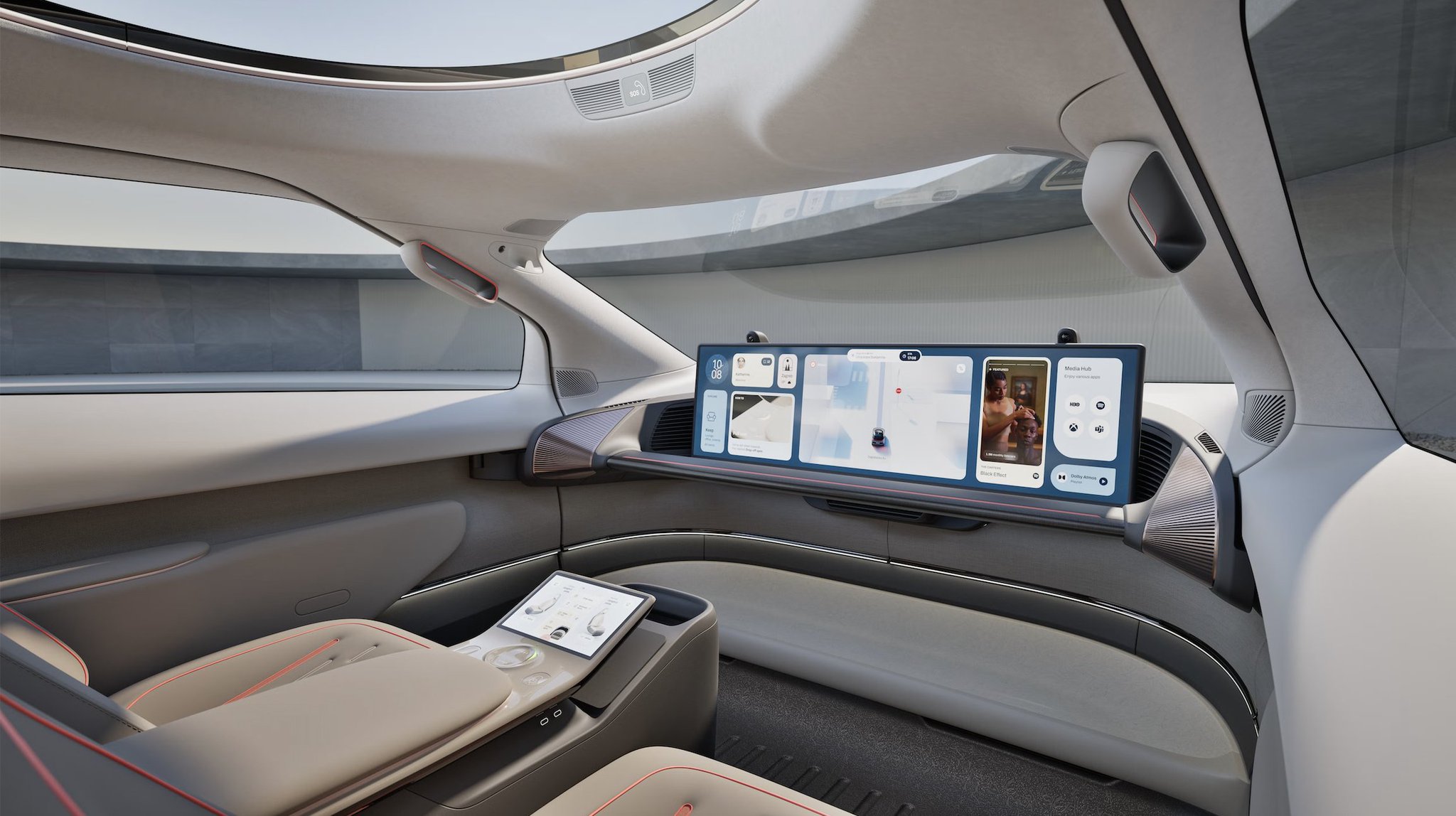
Feel like the Uber Comfort equivalent? You can upgrade anytime to something closer to this:
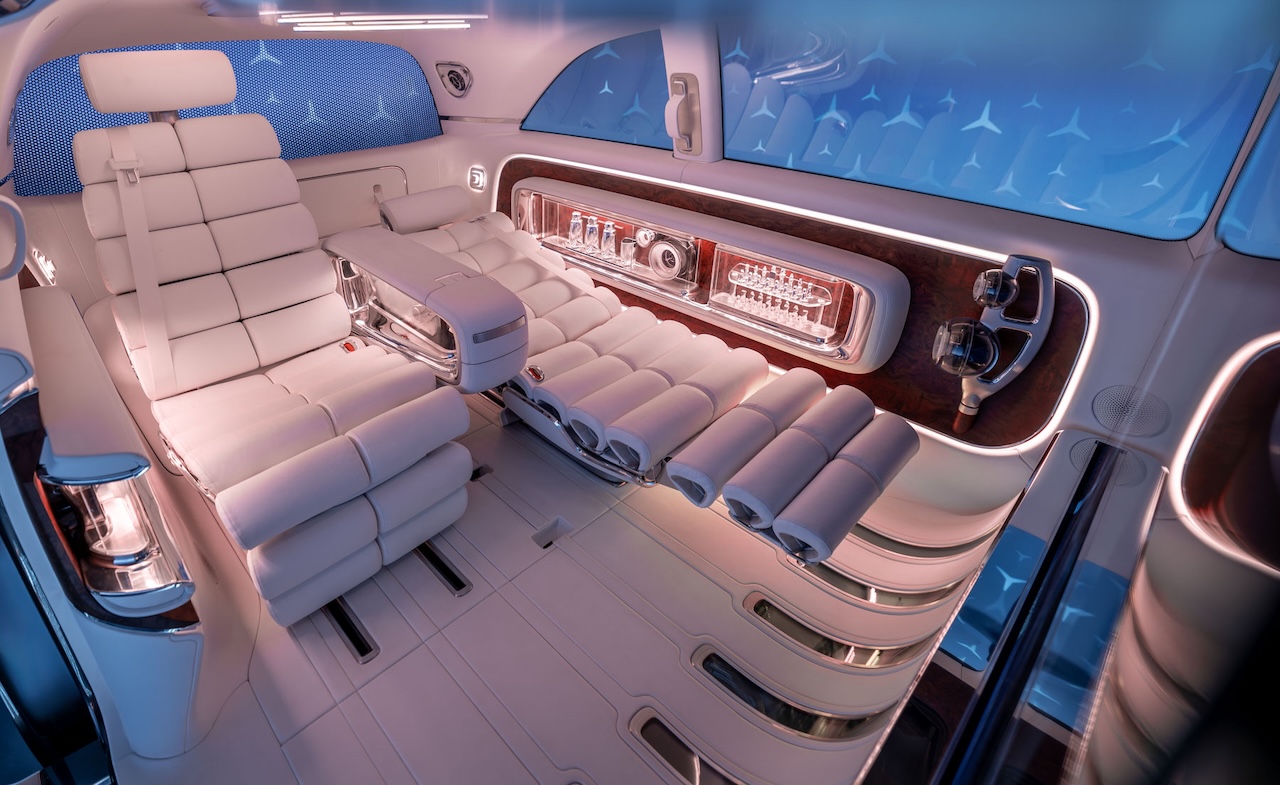
And since humans won’t run out of status games and the desire for luxury, there will be a high-end option, of course. Maybe something like Mercedes’ Vision V Concept:
The politics of it
The interesting geopolitical question is which societies run the experiment fastest. A country that funds its robot-butler free tier through voluntary data monetization looks very different from one that funds it through tax-and-transfer (yes, I am talking to you, EU).
We need to play our cards right (and a bit of luck) for this to work, the abundance outcome isn’t guaranteed. So what would prevent the Freemium World?
Energy stays structurally expensive. No cheap fusion, no abundant solar, and marginal costs don't fall far enough for the subsidy math to work across categories.
Baumol ceiling on robotic labor. The necessary last 10% of quality costs 90% of the money, so the free tier is permanently bad and users reject it.
Regulatory capture. Licensing, zoning, overbearing safety standards and IP protection prevent the cost curve from reaching consumers.
Monopolistic collapse. One or two AGI providers eat entire verticals and dominate, capture all the value, and eliminate the polypolistic structure that drives both tiers up.
The first three cap the floor. The fourth collapses the whole structure, because it kills the supply-side engine while leaving the demand-side engine (status games, desire for more) fully intact. A world with one AGI provider and uncapped human status competition is a world where freemium never emerges and the bottom 80% get nothing. This is the risk most worth taking seriously.
Final thoughts
The freemium world won't be announced and it won't arrive as a policy. It will show up the way Spotify showed up: a new tier on a pricing page.
Post-AGI abundance, if we get it, is going to look like a 2014 Samsung Galaxy being free for everyone, while everyone who cares pays for the 2025 iPhone. Same escalator we've been on for 200 years. Running faster, in more categories, with the business model we already understand.
The real question is who pays for the subsidies, and what stays behind the paywall.