Robots need a nervous system
Task completion is only half the job. A production robot also has to not die, not wreck its environment, and not hit you.
The usual debate about robot reliability splits into two camps. The scalers say the policy is fine, you just need more demonstrations, more homes, more hours. Others say the policy will never be fine and urge you to bolt on an e-stop, a constraint, a recovery switch, and hope the fallback is faster than the crash.
If you let a nervous system watch the body in the half-second before an accident at high frequency - that is the interesting interval - the system can get more resilient on its own time.
Task completion is only half the job. A production robot also has to not die, not wreck its environment, and not hit you. Those are different pressures, and they show up as a gain schedule: how hard to try, right now. Slight drift, gentle correction. Pan about to fall, maximum-force catch. Standing on a foot you didn't know was there, freeze.
That layer is closer to a nervous system than a brain. Foundation-model robotics is busy building a neocortex and, more recently, a task-oriented motor cortex.
The roommate problem
Jeff Hawkins, in A Thousand Brains, describes a control dispute. The neocortex is the organ of intelligence. It cannot move a muscle: none of its cells connect directly to one. When it wants something done, it asks the "old brain" (brain stem, spinal cord,…). The old brain may refuse. Breathing, flinching, yanking the hand off the stove: all controlled by the old brain.
Hawkins' conclusion for machines is to leave the old brain out. Don't copy the survival drives, the status fights, the aggression. On that, he's right. These mechanisms protect genes, i.e., lineage. In a robot, this is useless at best and dangerous at worst.
But gene-survival and body-survival are different jobs. A robot that cannot flinch is nonchalant and functional most of the time but dies easily in unpredicted chaos. This isn't acceptable in messy production environments at scale. A nervous system will be required - you can think of it as the VLA's roommate that actually holds the lease on the body.
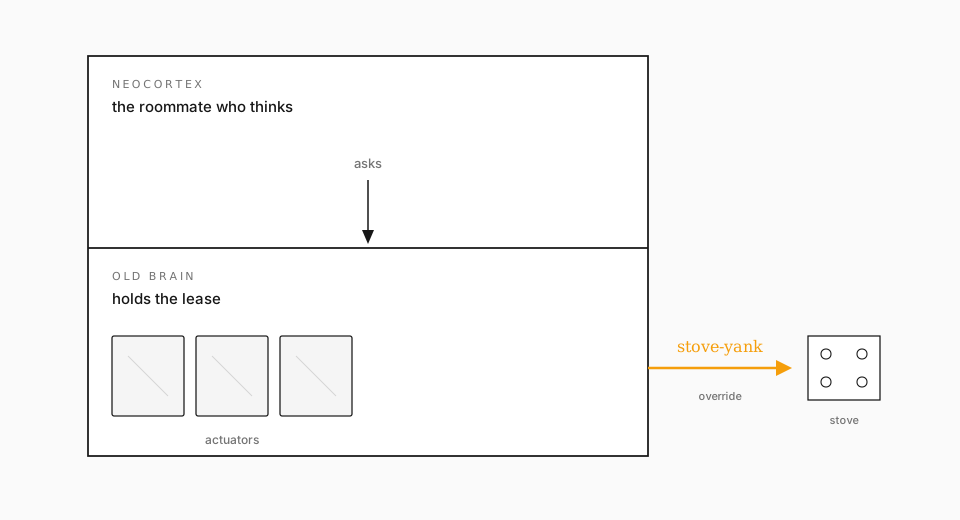
The neocortex asks. The old brain can veto.
The idea isn't new
Classical robotics already does low-level reflexes: impedance, damping, control barrier functions. Recovery RL split the job in two: a task policy that chases reward, a recovery policy that takes over when a safety critic says you're about to violate a constraint. That's a switch. FARL trains a recovery policy offline and a world-model critic that estimates near-future failure cost, then switches when the cost crosses a threshold. Bresa is the closest to a spinal cord: a risk critic that runs in the high-frequency control loop, and a variable-impedance controller that gets softer or stiffer as the risk moves. They had already connected a risk value to stiffness in previous work. Now, since the control loop is running at a higher frequency than the high-level task policy, the critic can interrupt a high-level action mid-execution.
The missing failure data
Teleoperators prevent valuable training data from being generated.
They do not let the robot "finish" a failure. The dataset you train on is a truncated distribution: successes, plus a few interventions. The failure and potential recovery - slight drift to almost-drop - is necessary training data for a nervous system. Unfortunately, teleoperator intervention overwrites that part.
In short, never letting a robot err and recover (or fail completely) leads to survivorship bias in your training data.
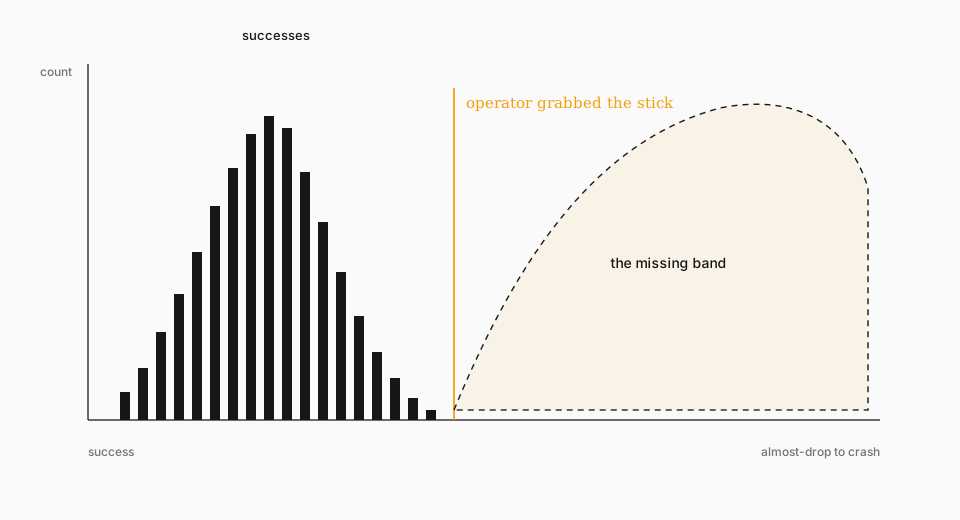
Survival bias with a joystick.
You can collect the missing band on purpose. Label a teleoperator's near-miss instead of discarding the take. None of that can emerge simply with "more demonstrations", because the demonstration's objective is task success.
Sidenote: MEM by Physical Intelligence (in-context adaptation) is a different animal. After a missed chopstick, the policy with memory tries a new grasp. That's live iteration, and extremely impressive. A reflex is different; it's reactive to an unpredicted environment change and its objective function is survival (avoiding catastrophic failure), not task success.
They're closing in on the data problem with Recap. π*0.6 learns from autonomous experience and from expert takeovers. The value function predicts time-to-task-success. But a nervous system predicts time-to-catastrophe. Similar critic shape, but opposite objective orientation.
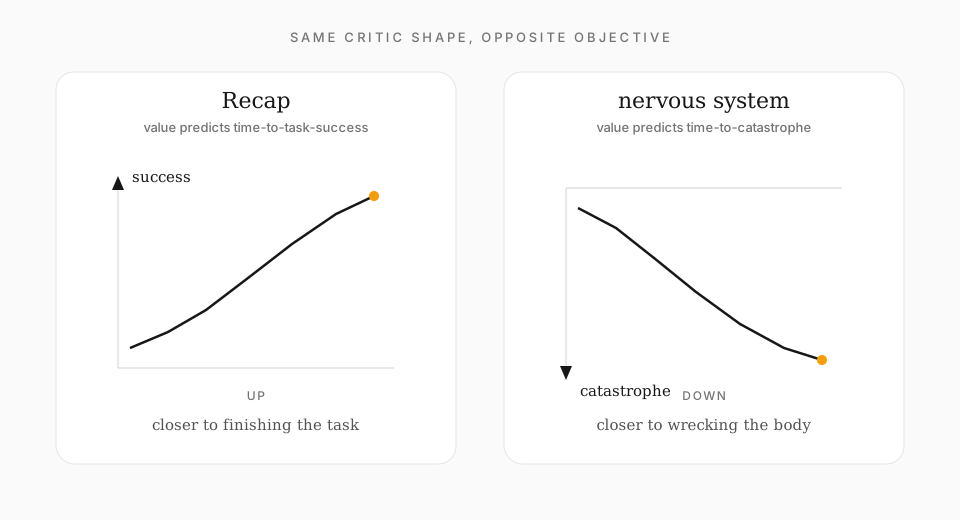
Recap's value is time-to-success. A nervous system is time-to-catastrophe.
Fast vs calm
A π-style VLA thinks in chunks. On π0.5, the low-level command is a fifty-step, one-second burst of joint targets, at fifty hertz, decent neocortex speed. In contrast, a hot-stove withdrawal is milliseconds. If the only safety system shares the high-level task loop, your robot will slip and fall at some point.
Hi Robot already split the stack into a slow language "System 2" and a reactive "System 1." But System 1 is still the VLA emitting chunks. The spinal cord has to sit underneath both.
Bresa's one real architectural point is this frequency split: the critic is allowed to be much faster than the thinker. Variable impedance is how the body complies with the critic when needed.
Generalist AI fused the clocks on purpose. Harmonic Reasoning, from GEN-0 through GEN-1 and GEN-1.5, is think-and-act in one stream: asynchronous sensing and acting tokens, no System 1 / System 2 split. GEN-1.5 emits 100 Hz action trajectories with thirty seconds of memory. GEN-1 can reach for a falling object as improvisation. If the pan is falling, the same forward pass that is planning the task has to also flinch. They are betting a fused brain can stand in for a nervous system - or include one. That layer, although integrated, still has to exist.
Harmonic Reasoning is a fascinating counter-claim from a leading lab and looks promising.
The outsourced old brain
On the customer floor, the lack of a nervous system reveals itself as frequent interventions by teleoperators. Robots freeze and get stuck, which is better than dying because they keep acting, but they still require human teleoperators for recovery. Weave's laundry robots measure success partly as fewer interventions from remote specialists.
Production already knows it needs a fast gain schedule. Today that is a human. The next model generation either eats that job, or we keep paying a person to be the fallback spinal cord.
What the layer has to do
I'd want this as a standard layer in robot foundation models, not as a lab add-on. Continuously estimated criticality plus continuously applied gain.
One scalar would be the cleanest version but doesn't work. Criticality can show up on different axes. Critical accidents can damage the robot, an object, or a human. The trickiest part - ethically and scientifically - will be to teach trade-offs and split-second decision when the robot has to prioritize one over another at different criticality levels.
Criticality is not one number. Human, object, self can spike independently and conflict. The layer has to output at least those three, plus an authority rule: who wins when they disagree.
What it does with a spike is also not one knob. Freeze, go soft, yank are different plant commands. A single number can represent and rank urgency. It cannot choose the recovery or avoidance action.
Similar to PI's critic-action framework that predicts task success continuously for live iteration, we might need an additional critic-action network predicting general critical events - not tied to task success or failure. It should evaluate criticality in three axes: damage to humans, objects, itself.
Figuring out trade-offs and conflicting recovery actions will probably be the hard part.
The current state
π0, FAST, π0.7: better brains, cheaper tokens, richer steering, including failure data as metadata. GEN-1 defines mastery as reliability, speed, and improvisation. Improvisation is a new plan but requires carefully calibrated bias to action.
A proper production robot will have a body that still has sovereignty over the actuators after the policy has already committed to a chunk. Reliable production robots at scale require not only common sense and motor skills, but some form of survival instinct hooked up to its reason and actuators.