End-to-end robotics for manufacturing
If we’re serious about reindustrialization and abundance, the scarce work is implementation that can absorb and benefit from ever-improving models.
I described a vision for an abundant world in an earlier article and I want to dive deeper into the mechanics that will make that world possible. A primary question here is timing and urgency.
If NATO allies are going to be independent, an independent core manufacturing stack is required. A lot of legacy/brownfield operations need to be upgraded and new greenfield plants need to be built. Why the rush? Eventually, a semiconductor and manufacturing crunch is likely to happen and we don’t control the timeline.
The variety and scale at which western manufacturing needs an overhaul makes conventional implementation impossible. Especially since the most needed technology is still in early development: intelligent automation.
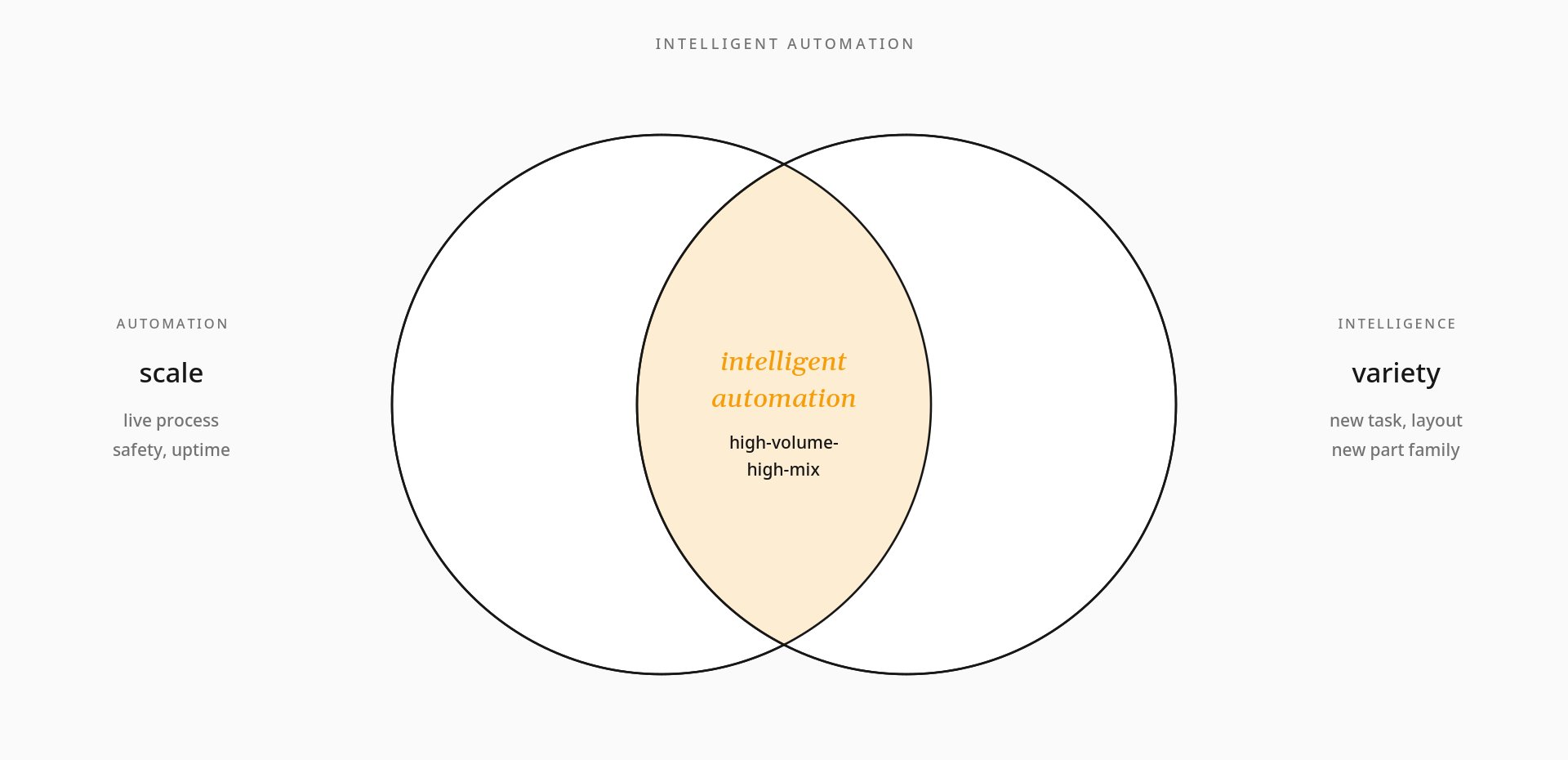
Intelligent automation enables high-volume-high-mix
We need high volume across highly dissimilar fields: energy equipment, munitions, vehicles, medical devices, consumer goods, and the upstream components of each. We’ll also need the flexibility to reallocate capacity between those fields as supply chains and demand fluctuate.
The only credible path is high-volume-high-mix
Intelligence in this context is learned, generalist physical capability: systems that can take a new task, a new layout, or a new part family without a lot of custom training for each variant. Figure AI, Physical Intelligence, Generalist, and a handful of other labs are a clear signal for scaling laws in robotics, and the results are promising.
Automation, on the other hand, is putting machines into a live process, with safety requirements, commercials, downtime, unions, dirty floors, and other brownfield constraints.
Those two worlds are still relatively disconnected. The intelligence side is foundational and early. The automation side is a fragmented collection of systems, from legacy to SOTA.
Something or someone has to fuse those parts together. This is where an E2E approach for intelligent automation comes into play.
The customer is the plant
End-to-end here means implementation, not a model architecture. A SOTA system taken all the way to a running mission on a live floor.
The customer is an American oil and gas shop, a brownfield power station, a hazardous cell that cannot move. Those stakeholders are not robotics or AI experts. They care about quality metrics for their own product, and someone else likely has to own the robot stack.
Software and LLMs already ran a lighter version of this experiment, with no hardware in the loop. Banks and hospitals still needed forward-deployed engineers sitting in the customer's workflow until the system worked as it should. Robotics inherits that requirement, plus a body and a physical safety case, which makes the job strictly harder.
Dominion Energy's Surry Nuclear Power Station in Virginia is a real-world example. In 2021, it bought a Boston Dynamics Spot, named it O-DE, and spent 2022 proving radiation surveys in the radiological areas of Surry, including outage support. The robot took the reading in the same place, at the same orientation, every time, and it can easily handle a dose a person should not take. The Nuclear Energy Institute gave Surry TIP awards in 2023 and 2024 for this work, first teleoperated and then autonomous. (Case study)
It’s a great proof point for the technology and also for this thesis. It required consultants, technicians, a two-month test plan, and a 24/7 direct line to the vendor. If that coordination is owned by the customer, the resulting overhead makes everything more expensive, slower, and harder to replicate.
Intelligence replaces modularity as the driver for versatility
Industrial system integrators already put robots in factories. Their main business is wiring known stock-keeping units into a known process.
The versatility of intelligent automation systems will emerge from their intelligence, not from the modularity of their SKUs. Integrators are excellent at catalog work but not at constructing a novel, potentially self-improving system on site.
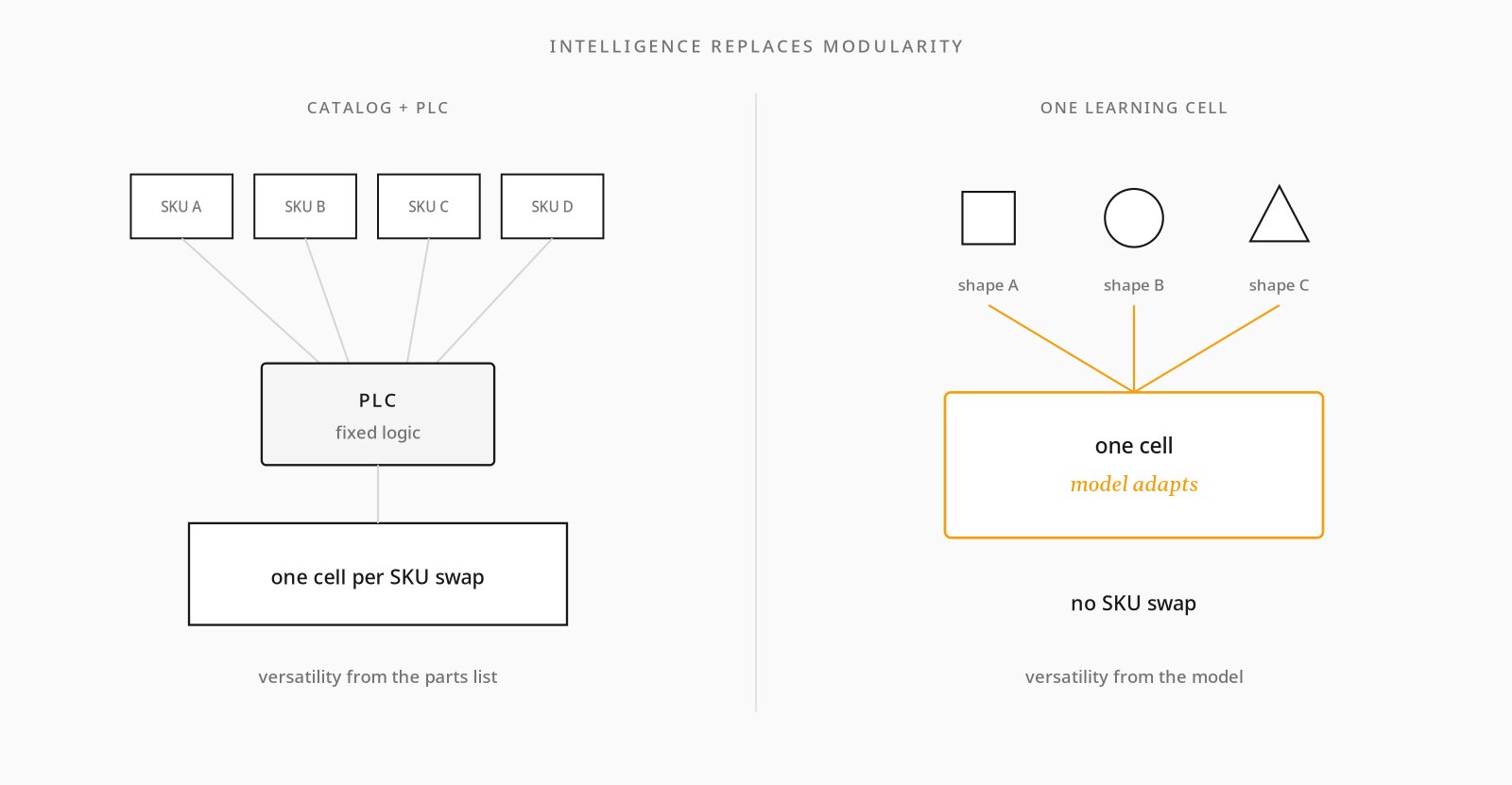
Versatility through SKU modularity vs. intelligent adaptation
Early computers needed system builders before they needed integrators. Language models needed forward-deployed engineers before they needed a B2B helpdesk. I believe we are in that phase for robots. Keeping the computer analogy, the question is: who will be the new IBM to build the first prod systems?
The end-to-end firm
What is needed is a single entity that unifies intelligence and automation for the deployer: one point of contact, to let the plant focus on its own product. That firm does four things:
- Design the system, based on the customer’s requirements and preferences
- Source components and technologies from hardware to software to models
- Assemble the stack into a system on site.
- Own uptime
That consolidation layer between frontier research and live reshoring projects is the product. I identified two approaches that split the market:
RobCo sells modular robots as a service into the customer's plant: hardware, no-code software, and the people who deploy it, on a robotics-as-a-service contract with no upfront capital expenditure. That is the in-plant model.
Hadrian builds and operates highly automated factories, then sells production. The work moves into a plant they run, potentially at the customer site. Either way, the customer inputs designs and receives parts.
The way forward
Manufacturing is impossibly fragmented, with an incalculable number of moving parts in critical supply chains. Improvements will compound, but not automatically (at least for now, that’s a topic for another article).
For proper reindustrialization and continued improvement, we need to implement systems that are capable of high-volume-high-mix production with a sufficiently simple and modular build to rapidly scale the implementation operation itself.
Of course, systems will still be “bespoke” or customized for each deployment, but the lion’s share of that last-mile customization will come from the intelligence layer, not the modularity.
Finally, we must keep in mind that this intelligence layer will improve more quickly than any other part of the stack. We have strong proof points for scaling laws in robotics and general physical models, so we can anticipate general improvements and build systems that will benefit from compounding progress.